Heatstroke (Hyperthermia)

Transform Your Dog’s Behavior.
Transform Your Family’s Life.
Discover the online program that more than 57,000 dog owners have used to rapidly transform their dog into a well-behaved, obedient furry friend.
Heatstroke (Hyperthermia)
Tiffany Cain, BS
Zoologist, Veterinary Services Department, Drs. Foster & Smith, Inc.
Heatstroke occurs when normal body mechanisms cannot keep the body's temperature in a safe range. Animals do not have efficient cooling systems (like humans who sweat) and get overheated easily.
A dog with moderate heat stroke (body temperature from 104º to 106ºF) can recover within an hour if given prompt first aid and veterinary care (normal body temperature is 100-102.5°F).
Severe heatstroke (body temperature over 106ºF) can be deadly and immediate veterinary assistance is needed.
Signs
A dog suffering from heat stroke will display several signs:
• Rapid panting
• Bright red tongue
• Red or pale gums
• Thick, sticky saliva
• Depression
• Weakness
• Dizziness
• Vomiting - sometimes with blood ¥ Diarrhea
• Shock
• Coma
What you should do
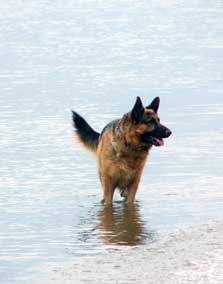
Remove the dog from the hot area immediately. Prior to taking him to your veterinarian, lower his temperature by submerging his body in water, keeping his head elevated above the water. Alternatively use a shower or hose to wet him down. For very small dogs, use lukewarm water; for larger breeds cold water may be used.
CAUTION: Cooling must take place gradually.
Cooling too quickly or allowing his body temperature to become too low can cause other life-threatening medical conditions.
The rectal temperature should be checked every 5 minutes. Once the body temperature is 103ºF, the cooling measures should be stopped. Even if the dog appears to have recovered before you reach the veterinarian, he should still be examined. He may be dehydrated or have other complications.
Place him on a wet towel and keep cooling the dog during transport to the veterinarian by keeping him wet, and running the air conditioner or driving with the windows open.
Allow free access to water or a children's rehydrating solution if the dog can drink on his own. Do not try to force-feed cold water; the dog may inhale it and will choke.
What your veterinarian will do Your veterinarian will lower your dog's body temperature to a safe range (if you have not already) and continually monitor his temperature. Your dog will be given fluids, and possibly oxygen. He will be monitored for shock, respiratory distress, kidney failure, heart abnormalities, and other complications, and treated accordingly. Blood samples may be taken before and during the treatment. The clotting time of the blood will be monitored, since clotting problems are a common complication.
Aftercare
Dogs with moderate heat stroke often recover without complicating health problems. Severe heatstroke can cause organ damage that might need ongoing care such as a special diet prescribed by your veterinarian. Dogs who suffer from heatstroke once increase their risk for getting it again and steps must be taken to prevent it on hot, humid days.
Prevention
Do not leave your dog in the car, muzzle him, confine him without shade, or confine him to concrete or asphalt surfaces. Restrict exercise, provide constant access to water, and keep pets with breathing problems indoors. Move the dog to a cool area of the house. Wetting down your dog with cool water or allowing him to swim can help maintain a normal body temperature.
Air conditioning is one of the best ways to keep a dog cool, but is not always dependable. To provide a cooler environment, freeze water in soda bottles, then wrap them in a towel or tube sock. Place them on the floor for the dog to lay on. You may also place ice and a small amount of water in several resealable food storage bags, cover them with a towel, and place them on the floor for your dog to lay on.
Overweight animals are more prone to develop heatstroke, so keep your dog at his optimal weight.
For more information on this subject, contact your veterinarian. Article reprinted with permission of: http://www.peteducation.com/ Owned & Operated by Practicing Veterinarians
Return from Heatstroke to GSD Check Up
When a dog wags her tail and barks at the same time, how do you know which end to believe?" - Anonymous
Sign up for promotions, news, discounts, and the chance to win prizes for you and your German Shepherd
