GSD search and rescue dogs are trained and ready to respond, whatever the situation.

Transform Your Dog’s Behavior.
Transform Your Family’s Life.
Discover the online program that more than 57,000 dog owners have used to rapidly transform their dog into a well-behaved, obedient furry friend.
GSD search and rescue dogs are only one of the many breeds of dogs that are used in search and rescue (SAR) throughout the country, but they are a breed that certainly excels in this type of work environment.
Because of the intense requirements of this job, not all dog breeds are suitable, despite what ever breed they happen to be but German Shepherds can excel as SAR dogs.
Physical stamina and strength, confidence, obedience, agility, trainability, temperament and socialization (with both people and different dogs) are just a few of the many factors that make a dog a good search and rescue dog.
Finding human scent is the main objective of SAR.
Search and rescue dog teams greatest single component is teamwork. Both the handler and the dog offer important and individual skills. When combined these skill sets result in a very effective tool for finding the subject of any search.
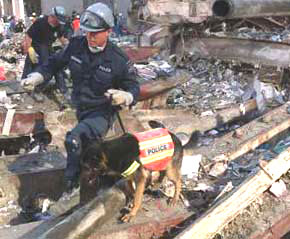
The handlers job is to must know First Aid, be able to navigate in wilderness and off trails, run the radio and any other electronic equipment used during the search, and be able to accurately "read" their dog's behavior during the search.
The dog's job is to be motivated enough to work confidently and quickly, covering terrain in areas that are difficult for most people to get into and to inform the human partner when he has located someone. The main job of a GSD search and rescue dog is to find a human scent ("find it") and then to alert his handler to the scents location.
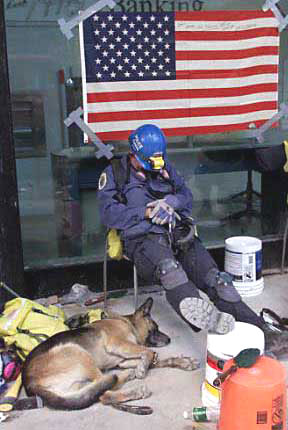
German Shepherd search and rescue dogs work mainly as air scenting dogs - meaning that they don't take scent from a particular article of clothing to look for a specific person. When air scenting dogs search, they will indicate the presence of any person in an area. Human scent is not only deposited on the ground as a person moves down a trail or through a forest - it is constantly shed, even when the person is not moving.
As a breeze or wind moves through an area, it carries the persons scent particles that can then be detected by a search dog. When the dog detects these shed dead skin cells (called rafts), the GSD search and rescue team can follow the scent upwind to the source.
German Shepherd Dogs are a very popular breed used in search and rescue. Typically these intelligent, obedient and agile dogs, along with their double-layered insulating coat and good nose are well suited for the job of SAR.
While some handlers may have a specific breed of choice in mind, any medium-to-large dog that is in good physical health, intelligent, obedient, well socialized with a strong play/prey drive could potentially go into search and rescue work. SAR dogs need to be big enough to successfully navigate treacherous terrain and yet small enough to transport easily.
GSD search and rescue dogs can work in many various settings, such as: finding a dead body under water, searching disaster areas for survivors and bodies, finding missing persons, locating evidence at crime scenes, searching for the scent of human remains, avalanche dogs search for the scent of human beings buried beneath up to 15 feet of snow, while urban disaster dogs search for human survivors in collapsed buildings.
A SAR dog must have the confidence to perform all sorts of tasks that are not part of his instinctive repertoire such as crossing a rope bridge, climbing a ladder, repelling with his owner down a mountain, etc.
This superb level of concentration is not about taking work seriously but more importantly about taking play seriously. Whether the team is performing a training exercise or a real search, it's all a game to the dog.As long as search and rescue remains a game, the dog will happily do his job until his handler decides it's time for retirement. Typically, a German Shepherd search and rescue dog retires when he can no longer handle the physical rigors of the work involved.
These GSD search and rescue dogs are on call 24 hours a day, 7 days a week, 365 days a year. It is easy to see due to the important nature of their work just how needed German Shepherd search and rescue dogs are.
Return from GSD search and rescue dogs to GSD Guide Dogs
"The dog is a gentleman; I hope to go to his heaven, not man's." - Mark Twain, Letter to W D Howells, 4/2/1899
Sign up for promotions, news, discounts, and the chance to win prizes for you and your German Shepherd